This article is super interesting for two reasons. One, the complexity of olfactory social cues in many animals is fascinating and seems to create a world of sentience and awareness that we have very little access to. Two, it shows (once again) that rats, an unfairly maligned creature, are capable of great care for others, as are many other social species.
“How do animals that help their brethren manage to prioritize those most in need? A new study shows that rats can use odor cues alone to determine how urgently to provide food assistance to other rats in need.”
Often it is useful, potentially even necessary, to have more than one cue for a behaviour. For example, most horses need to know a voice and physical cue for the paces and to move back from a light touch to the chest and a voice command. Dogs will clue into the point and “off” signals that come soon after that pleasant, muddy romp on the two-legs furniture. Rats learn the screeching and frantic hand waving that prevents them chewing, or at least tries to. And cats train their two-leg servants to clean up after them through a combination of auditory retching cues and olfactory ones which trigger retching. Below my dog Jack performs the speak command to a voice and hand signals to demonstrate a behaviour which has been trained to multiple cues.
If you are training an animal, or are a particularly well-read cat training a human, it is useful to be able to teach more than one cue for a behaviour without confusing the trainee. There are several ways duel cuing or multi cuing can be achieved. You can:
Teach the cues separately
Duel cue
Add cues to an established behaviour
Teaching Two Cues Separately
Often people teach two or more cues for a behaviour separately. For example,when teaching a horse to trot whilst free schooling a visual cue or a voice signal is often used. However, during ridden work the horse will learn trot from a physical cue – a light touch with the rider’s legs. The desired end behaviour is always the same despite more than one type of cue. Separate, multiple cues can be taught to animals in this manner, the same way the horse is taught to trot from a voice command from the ground and a physical cue on board. Although, occasionally you may find that the cue-response establishment becomes dependent on the situation and that the cue may not transfer to other situations (a process know as generalisation). Lots of horse that free school very well will do the ear flick of confusion if verbally asked to trot whilst ridden. This can be overcome by introducing the cues in a range of environments so that they don’t become place or time specific.
Duel Cues
Most duel cues are taught almost accidentally by the cues appearing together during training. Animals, like humans, have implicit cognitive processes specifically designed to quickly identify patterns of events within environments, whether said patterns are circumstantial, correlatory or causal. The implicit mind is responsible for or has a hand in several human behaviours, including what we call ‘gut feeling’, stereotyping, superstitions and learning. For an animal, picking up on the pattern of the cues associated with the behaviour and reward will result in the animal registering both cues as being associated with reward when a certain behaviour is performed. Humans learn associations in much the same way, if you want someone to wash up more often, make sure something pleasant happens soon after and repeat until the washing up behaviour is established. The pleasant occurrence may include a beer or chocolate appearing in the hand of the trainee after the desired behaviour, or maybe just some affection if you are of a mind to be subtle in your human training, or of course, if you are a cat and limited in your reward options.
Back to non-human animal training. A common duel cue is the use of the word “off” and a physical pointing gesture to train an animal to move from an area. both cues are associated with the “off” behaviour being rewarded (assuming the correct training protocol is being used, even if the cream sofa now has muddy paw prints on it).
Duel cuing, thanks to the incredible quickness of animals ability to pick up patterns, is often a successful way to teach two cues for a behaviour. However, occasionally the animal can become stuck needing both cues to perform a behaviour or only learn one of the cues. To solve the animal needing both cues try fading one cue and making one more obvious whilst rewarding the response behaviour until the obvious cue alone will trigger the behaviour. Then reverse the process until both cues trigger the wanted behaviour. If your pet/trainee has only learnt one cue and not the other, the second cue can be taught separately or added as described below.
Adding Cues
As not all training can be planned in advance, sometimes extra cues need to be taught to the animal. It is possible to add additional cues to already established cue-response behaviour patterns. This is how we taught Jack to speak on command to both a voice signal and a hand one. When we first brought him home from the rescue all those years ago, I did a lot of training with him to help establish a relationship, to help him settle in and just for fun because he is a very smart and happy dog to work with. As part of our training Jack was taught to speak through association training, if he barked I said “speak” and rewarded verbally until me saying “speak” caused Jack to bark. There are other ways to teaching the “speak” command but this one is good fun and without pressure. If your dog is liable to be over enthusiastic with the barking you can also teach a silence command or train specifically for one bark.
Once the “speak” command was taught, I thought it would be fun to teach a hand movement to also cue a bark. I paired this cue with the voice command several times, rewarding the response, and then faded the voice command very gradually and emphasised the hand movement until both the hand movement alone and voice command alone would result in a bark from Jack. The same procedure can be employed to teach two cues for other behaviours.
*Note* Some people worry that teaching a bark command encourages off command barking, however, I have never found this to be the case unless the dog is confused about the cue. Certainly Jack is never a problem barker, although he will gently, but persistently, moan at you if you are writing a blog post at walk time.
I share my life with 3 very fat, very lovely rats. Yes voluntarily! No not because I missed the bin collection too many times. I have been sharing my house with these rodents most people condemn as unwanted vermin for almost 20 years. It’s been comedic, a privilege and a learning experience, so here are a few life lessons from rats:
1. They’re more like guidelines anyway.
Rats do not like to obey rules, particularly your rules and why should they, who died and made you King/Queen of rats. This is most true of 2 favourite rat pastimes: chewing and getting into places they aren’t allowed.
Didn’t want the rats to chew the wall paper, the door, your favourite t-shirt, your lucky pants? You can guarantee that will be the only thing the rat wants to chew. My usual conversations with the rats regarding this topic go like this –
Me – Hi my rat friend, I see you are trying to chew on that speaker cable again.
Rat – Speaker cables are a key dietary staple of rats, giant creature of food and cuddles.
Me – Well no, no they’re not but moving on. They are dangerous and you have already cost me 30 quid in speakers. You never chew any other cable type so I am assuming this is some sort of ratty humour?
Rat – *looks cute and wanders away to other mischief*
Me – *Hears gnawing* Rat why are you chewing on the cable again we have had this conversation.
Rat – Tis tasty. Like food but not.
Me – But I have bought you many objects for you to chew. Some of them taste like actual food. You have yet to lay a tooth on any of them.
Rat – Not same, does not taste of the sweetness of mouth victory nor invoke hairless human things to make noises.
Me – Seriously you need to stop this.
Rat – But must eats cable absorb its tasty power?
Me – No never eat the cable.
Rat – So cable?
Me – No never cables.
Rat – Ok, just for you …. 5mins later … *gnawing sounds*.
Conversations regarding getting into places they aren’t allowed go the same way. My advice; don’t store anything which won’t be improved by teeth marks near a rat. Resign to redecorate. Assume that the rat will be wherever it is not supposed to… if they are not currently in that locale, trust me they are plotting something.
The lesson: well sometimes in life you have to have to break a few rules to reach your goal and find the contentment that only chewing on a speaker wire… I mean… that a little bit of ethical anarchism can bring.
2. Be persistent, very persistent!
Rats are the most tenacious creatures you will ever meet. If they have a goal, whether it’s one you approve of or not, they will spend as much time and effort as necessary to achieve it. I have seen rats spend a lot of time trying to get to small morsel of food they aren’t allowed, even at the expense of eating a whole bowl of food near them. Because that morsel of food is out of reach and/or near me the rats become convinced it is a divine food that has been imbued with heavenly flavour far beyond their bowl scraps (often it’s the same food). More often than I would like to admit they get the food, either because they invoke their rat ninja powers (seriously rats are tiny ninjas never forget this) or I give in because I am a soft touch.
One of the most annoying ways this admirable trait of tenacity manifests is when they want to be picked up. They will do everything in their power to make it impossible for me not to pick them up. Their list of favourite moves includes foot riding, leg jumping, when leg jumping fails leg scratching, trying to trip the human creature and hanging of the human creature’s jeans by the teeth. Last time I checked, which to be fair was not recently, live rat leg accessories were A) not at all fashionable and B) highly frowned upon by most welfare groups, so they end up being picked up.
The lesson: persistence will usually, eventually get you somewhere you want to be, until you trip the giant and get stood on anyway.
3. How to deal with conflict.
Rats are a make love not war sort of creature, a little too much really, seriously stop humping each other. It is very awkward when you get your humpy ways on in front of my friends, but given that you go out of your way to ensure a full view, I expect you know that. Luckily my current 3 boys have now become too old to show much interest in each other that way. They are definitely moving into the slippers and snuggles phase of relationships. But when they do fight (well have lovers tiffs) rats have a number of mostly ineffective and highly amusing argument techniques. Below are their favourite moves in order of escalation:
The Grumpy Cuddle – Like a normal cuddle but I am annoyed at you for pinching the bit of pasta I wanted last night.
The most Dramatic and Unnecessary Squeak – Sound like you’re dying, it will at least throw off your opponent for a while.
The Bitch Slap – As it sounds. Thought you were getting the water bottle first … nope *slaps*. All rats are apparently very camp and got all their fighting skills from watching bad American soaps.
The Butt Thrust – Enthusiastically stick your butt in your opponent’s face, rigorously repeat as necessary until they get fed up of your butt and go away.
The Shuffly, Snuffly, Hedgehog Haka – The shit is really hitting the fan and it’s time for the big guns so puff your hair up until you look like a hedgehog, sniff as ferociously as one can sniff, and do a dance like a cute Haka, this is sure to win you any fight!
Life lesson: well er… mainly I am just warning you about how I now fight. No seriously, the message is don’t fight and when you squabble, never squabble in any way that isn’t hilarious.
4. No grudge matches.
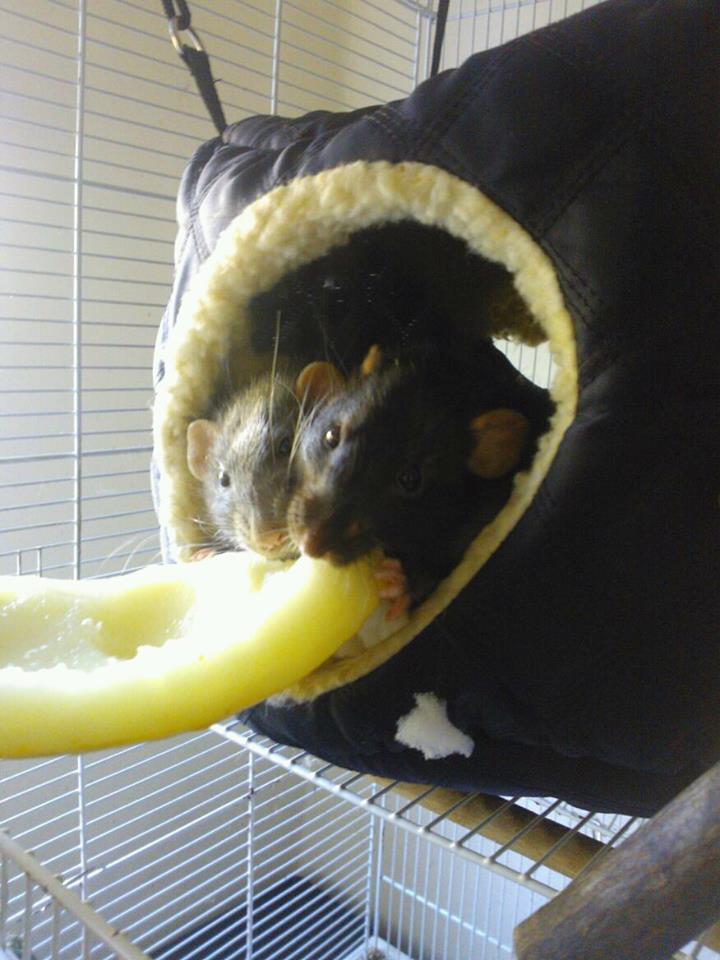
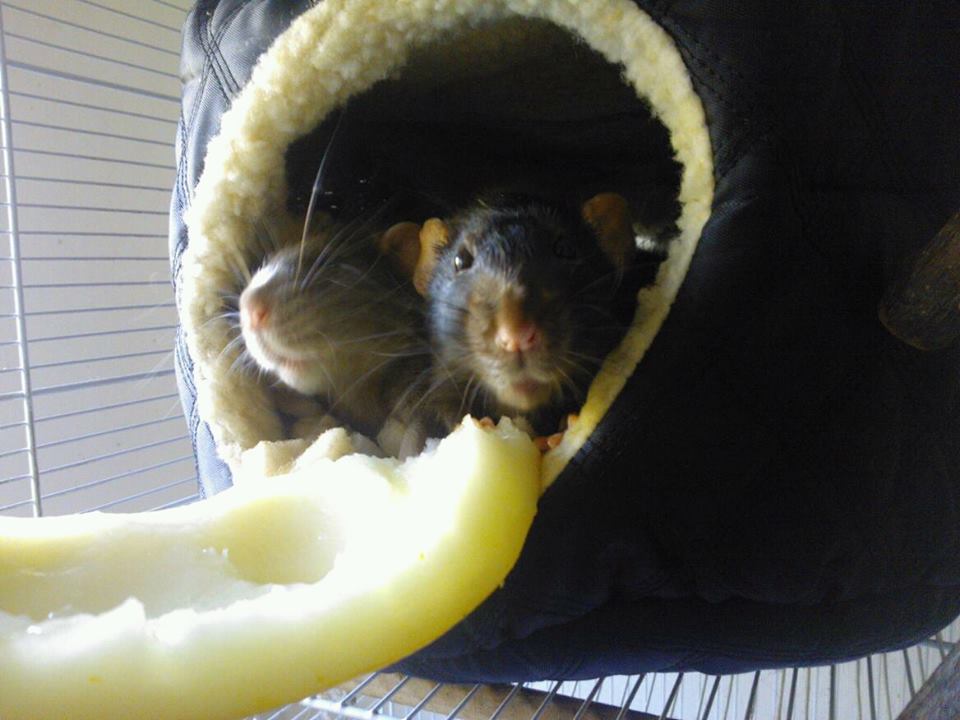
The very few times I have seen rats have ‘serious’ tiff, well as serious as a fight can be when your big hairy butt is your primary weapon, I have noticed that rats don’t hold grudges. They never go to bed angry with each other. Even when a serious rat misdemeanour has occurred in the group, like taking the last bit of biscuit or hogging the food bowl or not sharing the banana … well most rat crimes are food based, this is how I find them in the morning:
The lesson: Squeak and squabble and butt thrust if you must, but make up and cuddle, life is too short to hold grudges rather than nuzzle in a hammock.
5. The simple pleasures.
Rats are hedonistic creatures, they eat a lot, sleep a lot (preferably in a hammock or extremely padded area), play like they are babies even when they are getting grey around the whiskers and thoroughly enjoy their lives. They frolic like the Greeks gods themselves and create more mischief and havoc than the Norse ones. If Loci made a creature in his image it was definitely the rat. It probably helps that they live a life of pure luxury; I wish my bedroom came complete with numerous hammocks and a giant food bowl.
(Breakfast in bed)
Rats revel in the pleasures of their environment and in the company of both each other and their human food delivery and snuggle machine. They rival dogs in there joy at seeing their human return. They also have the same perplexing quality in that they don’t seem to care whether you have been gone 5 seconds or 5 hours*. Rats have excellent memories so it can’t be that. Anyway a pet rat will always brighten your day, because when every person in your life is giving you grief, a rat will always be terrifically pleased to see you, just because you are you (well and because there is the off chance of biscuits). Had a really bad day and need more than one happy ratty pick-me-up, just close the door for 5 seconds and repeat the experience all over again!
Rats: Why you gone so long mummy human? Us much sad.
Me: I was gone 5 mins.
Rats: No was soooo long.
Me: It wasn’t long, I just went to get you food.
Rats: FORGIVEN!
The lesson: try to enjoy life, particularly the simple, little things as they are more constant. Revel in the pleasure of being with those you love, although maybe don’t show that love through enthusiastic humping and climbing onto their shoulders. Eat with a bountiful enthusiasm and don’t spend life prudishly, denying yourself things.
*Unless you want to see them before 9am, in which case you will mainly be squinted and yawned at, but I can understand that, they don’t even have caffeine to help with the pain that dawn brings.
6.Onwards to adventure.
As you might expect from a society of anarchist ninjas, rats love adventures and generally trying to get themselves into trouble. One of the first things you will notice if you ever get a pet rat is that one of their favourite things to do is ride around on shoulders. Forget parrots, Long John Silver should have had a rat. To a rat, you are a superb mini adventure playground you can be climbed, explored and ridden around on. Unfortunately shoulder riding comes with some issues, for the human.
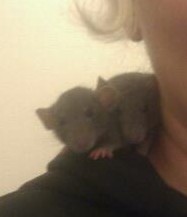
When you get rats, if you get them young, they are tiny, really tiny. I mean look at them so adorable, several of them could fit under one ear (see picture below). Don’t be fooled though, they grow, and they grow, and they grow A LOT, the same rats are in the other picture below. As you can see it is now incredibly difficult for me to hold all three of them at the same time but despite this they still want to sit on my shoulders, all the time and all at the same time. Luckily they are always careful not to push each other off, unfortunately they are not so careful about scratching my neck. Even the smallest, unintentional slips with their tiny razor like nails can leave me with large red scratches down my neck/chest. As you can imagine these make my private life look rather er ..adventurous, and result in me getting looks from humans that range between amused and judgmental. Surprisingly, these looks often don’t change when I explain they are due to rats and not kinky bedroom antics.
(How’d you get so big!)
As rats get older their lust for adventure does not diminish, but unfortunately their physical prowess does. This doesn’t stop them though. One of my rats has hind leg degeneration but he still wants to climb everything, including shoulders. His determination is both impressive, if inconvenient.
Shuffler: Up, up, higher and up
Me: No you can’t do that anymore, remember?
Shuffler: But whys?
Me: Well …
Shuffler: Is cos older?
Me: Well….
Shuffler: Is cos legs not work so good any mores? *looks sad*
Me: Er …
Shuffler: But brothers allowed up *looks sadder*
Me: Fine ok.
Shuffler: Yay up, up, up we go… little help?
(Spends the entire time almost slipping and terrifying me)
Sometimes rats have adventures for no reasons. I had one tiny, rescue girl rat called Monster, who had a passion for climbing the tiny pipe in the corner of the room. She would scoot up there and survey her kingdom before fireman sliding her way back down. Despite the fact I was terrified she would fall and did everything in my power to block her path, without fail there she would be, up in the corner of the room by the ceiling, then wwweeeee she would come sliding back down. As has becoming a theme, eventually I just let her do it; it just made her so happy.
The lesson: have adventures and be curious, even if it’s for absolutely no rational reason.
7. Kindness begets kindness.
Despite a reputation worse than David Cameron’s, for being crueler than Ian Duncan Smith, more vicious than Osborne and more spiteful than Michael Gove, unlike the current UK government, rats are actually gentle, caring creatures. Yes, I know there was that whole unfortunate plague incident, but let’s just put that almost ancient history aside for a moment (besides it was really the fleas anyway).
I have had 10 rescue rats, some of which had less than ideal starts in life, certainly with regards to their experiences with humans, despite this I have yet to be bitten by a rat. Even when humans had neglected them and terrorised them, even when they were terrified and confused, even when ill or in pain, if I showed them kindness they showed it back. A lot of humans are not so generous in character. This nature makes them very easy to live with and because they are naturally forgiving, of all the smaller pets, they also one of the best with children, and let’s face it takes a very forgiving nature not to bite small children.
Rats show empathy to each other as well as humans. Rat empathy has even been studied scientifically, below is a video of one rat freeing another in a scientific study*.
But rat owners can quote many, many more incidences of helping, kindness and empathy between their pets. In fact it is so common that writing about anecdotes becomes hard. However, their kindness to each other is most obvious when they become ill or frail. I have seen rats give up that preciously, rare resource – food for a distressed or frail friend and if an ill friend can’t reach the top level of the cage, they will give up their preferred sleeping area to keep them company. Despite often being rambunctious and play fighting with each other, rats will temper their behaviour around their friends who can’t cope with the incessant food pinching and butt thrusting anymore. This same kindness will be extended to you when you are sad or ill. Rat cuddles are the best therapy.
The lesson: act with kindness, even to strangers and even if people have hurt you in the past, you will be happier. Care for those around you, even if you really want the last biscuit or the best place in the hammock, they need it more.
*You can find out more of the science using Google, or if you are feeling ambitious google.co.uk/scholar
A final word – Today is more important than tomorrow.
I will finish on a short one, rats live tragically short lives. Particularly short and illness filled if they have been bred on rodent farms, like the ones commonly sold in pet shops, rather than by a proper breeder (yes, get dedicated rat breeders, crazy huh). Despite the shortness of their lives (the oldest rat I had got to 5), they live every moment fully. They are all about the now. Rats are some of the most incredibly sentient, conscious, energetic and vivacious creatures you will meet. They fill a lot of joy and love into their short little lives and, really, isn’t that all any of us can hope for.






 Emma Lethbridge Horsemanship