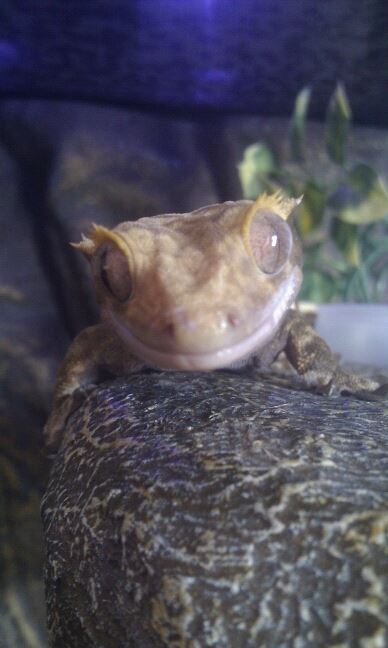
 Despite having had a good amount of experience handling reptiles of various shapes and sizes, I have never owned one. That was before I rehomed Tali, a crested gecko of no known age or sex (though I suspect female). If you are unfamiliar with Crested Geckos they look a little like someone shrunk toothless from How to Train Your Dragon and tie dyed him with pretty patterns.
When I first got Tali she was quite flighty. Certainly she was not happy being picked up, although she settled once held for a while. However, I don’t like my animals to feel stressed at any point when interacting with me so I started trying to train her to be tame to handle and come out of her exo terra of her own desire. However, reptiles are rather different to train than mammals, so here are some tips on training your gecko for stress free handling.
- Give them time – Lots of time! Seriously think of reptile training as an exercise in mediation. They only have little brains after all, you need to give them time to process what is happening and what decision they want to make. A week in your diary per session should do it.
- Beware the Abyss Leap – Crested Geckos are an arboreal reptile (they like to live in forested areas). They particularly like to point this out by crashing about at bed time. Despite this love of leaping they are not particularly accurate leapers, nor do they care for accuracy. Look before you leap is not moto Cresties stick to, probably because they stick to anything. Anyway if you see your gecko hunch its back legs and star longingly into the air be careful to provide a landing surface. Should your gecko land awkwardly (which is a lot of the time) you get the fun of finding out that geckos have tiny adorable claws, which they prefer to use for hanging off your skin.
- Positive reinforcement is difficult but not impossible – Unlike mammals and some other lizards, crested geckos are difficult to positively reinforce as they do not have a particularly voracious appetite and like most reptiles, though not all, are not a great fan of enthusiastic petting. However, you can make being out a pleasant experience. Make the room quiet and a good tem
 perature, a too cold or too warm gecko is not a happy gecko. In the same vain make your hands a desirable temperature, if it is a hot day a little cool and vice versa. Making your hands a comfortable and safe place will go a long way to reinforcing the gecko allowing itself to be handled and being happy to be held.
- Preferences and personality – Geckos do have preferences for handling style so stick to whatever your gecko prefers, Tali likes to hand walk and will happily explore in a safe area without trying to escape. She also has a preference for night time handling. Interestingly they also have personalities; some are braver than others, some more flighty, training needs to reflect this.
To train Tali to walk onto my hand at first I would just present my hand to her. To begin with she would only inspect the hand monster, mostly in the form of licking, this is where that patience comes in. Once she had finally discerned that it was definitely not edible or dangerous. Then she would maybe place a foot on the hand monster. Now after much gecko based meditation she is happy to walk onto my hand and for me to lift her. Starting small and building up has been the key.
The basic things that indicate that Tali is now comfortable being held are; one she initiates handling by climbing on my hand, two when scared she now hides in my hands if startled rather than trying to escape, three she is very relaxed when hand walking and four she comes to the glass if I am nearby and she wishes to have an adventure.
Here is a little video:
Good luck gecko training!

 Emma Lethbridge Horsemanship